The Amp: Past, Present & Future

A president of the United States partnering with corporate overlords from the nation’s largest ski resort might seem unsurprising these days, but 50 years ago, one such then-groundbreaking relationship helped birth the Gerald R. Ford Amphitheater.
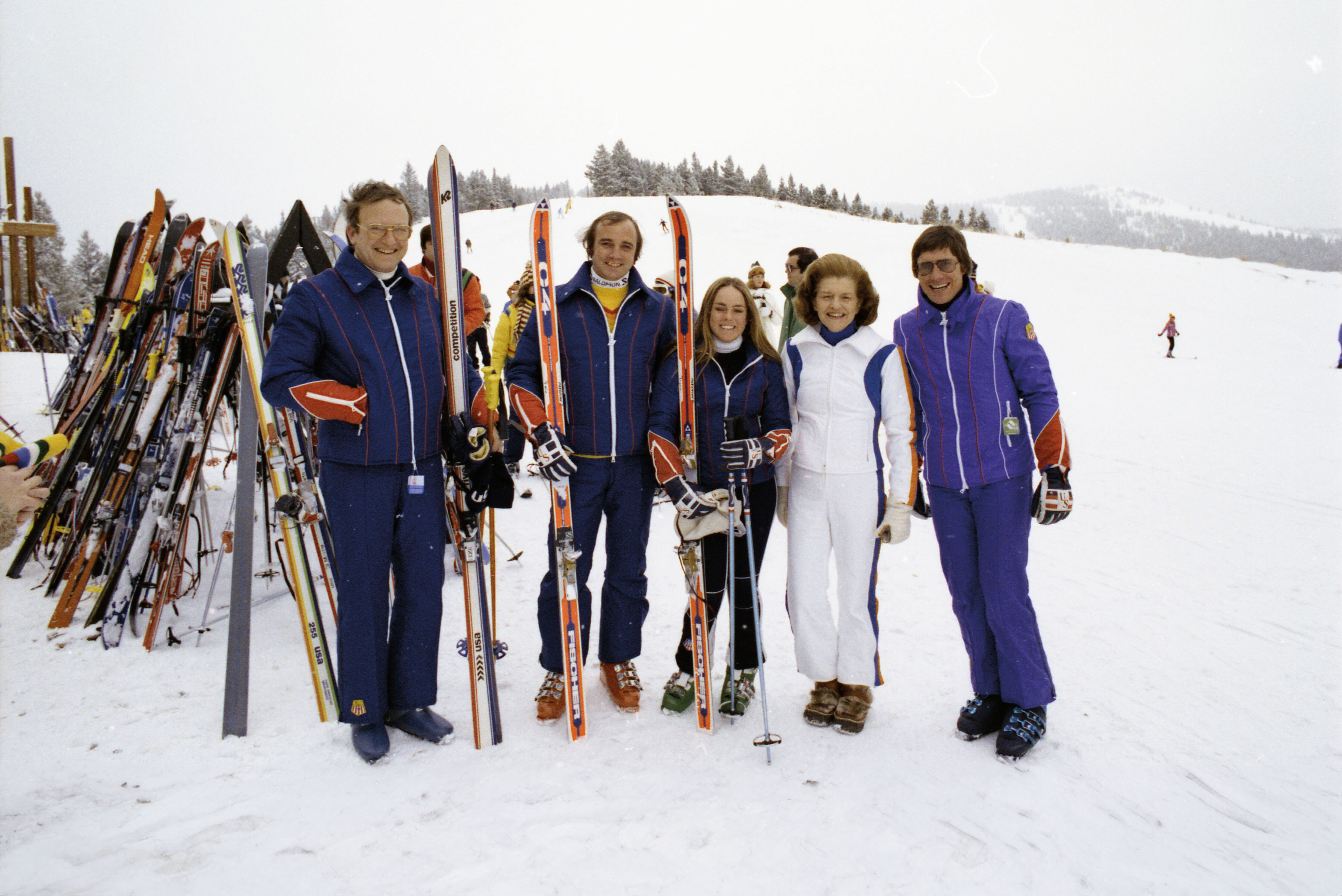
It all began in 1968, when Gerald R. Ford, then a congressman from Michigan (and an avid skier), his wife Betty, and their four children, felt the gravitational pull of America’s newest ski town and spent their first Christmas in Vail. They purchased a modest three-bedroom condo at the newly constructed Lodge at Vail but quickly outgrew it as he became vice president, and then president of the United States following Nixon’s resignation in the summer of 1974.
During his three years as president, Ford’s winter White House in Vail was the 1960s-era A-frame home of Texas oilman Dick Bass on Mill Creek Circle. Post-presidency, the former first family continued to vacation in the Vail Valley, purchasing a 12,000-square-foot estate under Beaver Creek’s Strawberry Park lift in 1982, two winters after Vail’s tonier sibling resort opened for skiing.
It was then that the president and Mrs. Ford truly fell in love with the Vail Valley; they used their influence to champion its development, particularly around arts and culture. In 1981, Vail Associates—now Vail Resorts—created the Vail Associates Foundation. With input from President Ford and many others, that evolved into a standalone nonprofit, the Vail Valley Foundation (VVF). Today, the VVF oversees artistic, athletic, educational, and community-oriented programs throughout the valley, including Beaver Creek’s Vilar Performing Arts Center (which the Fords also helped establish in the late 1990s) and Ford Park’s crown jewel, the Gerald R. Ford Amphitheater—also known as The Amp.
“Those elements weren’t random choices,” recalls Harry Frampton, a close friend of the Fords who served as president of Vail Associates from 1982 to 1986 and as the VVF’s board chair for the nonprofit’s first 35 years. “They reflected what we believed our community wanted and what would define us as a world-class destination. The Gerald R. Ford Amphitheater was a direct expression of that vision. We believed that if you built something extraordinary, the community would embrace it and the world would follow.”
After the Town of Vail purchased the greenspace that would become Ford Park in 1973, early supporters of a public outdoor amphitheater raised enough money to build a foundation and begin installing seating. But donations lagged, and the project stalled; grass, weeds, and sagebrush overgrew the site, which didn’t yet include a stage or roof, and public support waned.
Within five years of the VVF’s founding, Frampton, along with two VVF presidents (John Horan-Kates (1981–1986) and his successor, Bob Knous (1986–1990)) and President Ford (who served on VVF’s board for more than 20 years), helped the nonprofit expeditiously raise the $2.2 million that was required to complete the amphitheater’s seating, lawn, stage, and an initial roof system. The Town of Vail also contributed; VVF has always operated the venue under a long-term land and facility lease agreement with the town.
“President Ford gave us something you simply can’t manufacture: credibility,” says Frampton, who oversaw the development of Beaver Creek and first met and befriended the president not long after the Fords moved into their Strawberry Park home. “When he picked up the phone to call a potential donor, or when his name was attached to an event, people paid attention.… A lot of people thought we couldn’t do it or that it wouldn’t be successful. We were determined to prove them wrong.”
The music begins—and evolves
On June 27, 1987, the Fords and Bob Hope and his wife were among the luminaries filling all 900 reserved seats (at $100 a ticket) and the 300 who gathered on the lawn (general admission tickets were $25) at the amphitheater’s sold-out grand opening celebration. Two weeks later at the venue's first major concert, Willie Nelson dazzled with hits from his top-charted album The Promiseland and a new release, “Island in the Sea.” Other shows that season included the Colorado Springs Symphony, Alvin Ailey American Dance Theater, violinist Nadja Salerno-Sonnenberg, the Vail Symposium’s women’s presentation, the US Army Chorale and Band, and the first iteration of the venue’s Hot Summer Nights free concert series for locals.
“We had no anchor tenant, no guaranteed programming,” Frampton recalls. “We built it on faith and a belief that this community deserved it and would show up for it.… Once people experienced it, they kept coming back.”
President Ford also promoted his namesake amphitheater by hosting the annual Ford and Friends concert alongside the Jerry Ford Invitational Celebrity Pro-Am golf tournament, which drew prominent public figures and A-list talent.
Bravo! Vail was established in 1987, and the following year, it debuted at the Ford Amphitheater as a small chamber music series, subsequently evolving into an international classical music festival featuring top-tier orchestras every summer.
“The Amp is intimate, unique, and shows off the very best of Vail,” says Bravo! Vail President and CEO Caitlin Murray. “Our audiences tell us how much they appreciate being able to experience some of the greatest orchestras in the world while immersing themselves in the natural beauty that is Colorado. Our musicians love it as well. And you never know when the birds will start to sing along or a curious squirrel may run across the stage mid-concert.”
The Vail Dance Festival owes its longtime residency at The Amp to a lucky break. In the summer of 1989, as the Cold War was winding down and just before the fall of the Berlin Wall, Houston, Texas, rescinded its offer to host Moscow’s Bolshoi Ballet Academy. Seizing the opportunity, VVF President Bob Knous raised $150,000 in one day and invited the company to instead perform at the amphitheater, an event that evolved into the Vail International Dance Festival.
“That changed everything,” says Frampton, noting that the event brought critical mass and gravitas to the venue’s summer programming. “Every year, the festival has gotten better.”
In 2006, Damian Woetzel became its artistic director, leveraging his far-reaching relationships within the dance world to add big names and reliably fill the house with dance fans from around the world.
“Damian is the signature of that level of dance,” adds Peter Blosten, general manager of the Gerald R. Ford Amphitheater. “He brings in all these artists every year that are just unbelievable.”
In 2017, the GoPro Mountain Games Mountains of Music moved from Vail Village to The Amp. A year later, the VVF partnered with AEG Presents to attract more headliner acts, including Robert Plant (2018), Trey Anastasio (2019) and Death Cab for Cutie (2021).
“AEG’s buying power and their impact in the state and beyond is what really allows us to bring in the Robert Plants and the Bob Weirs and the Ray LaMontagnes of the world,” explains Dave Dressman, The Amp’s vice president. “It has really elevated the amphitheater to a level that it had not seen before the partnership.”
“Live music in Colorado is massive, and we like to be at the top tier of it,” Blosten adds. “Artists really love the energy we have. One band came through and said, ‘The soul that you guys have in this building is exactly what we’re looking for. This is what it’s all about.’”
During pandemic shutdowns, The Amp, with ample open-air seating that allowed it to operate within the strictures of social distancing, was among the first performing arts venues in the nation to reopen on July 11, 2020, with a movie night on the lawn and a limited-capacity Hot Summer Nights concert.
Once restrictions lifted, Michael Franti opened the 2021 summer season, proclaiming to an enthusiastic crowd: “Live music is back, y’all.” The Grateful Dead’s Bob Weir followed with two shows that were recorded and released as an LP in February 2022.
“It was the first time we had gathered en masse in over a year, and those shows were about as powerful and magical as you can get,” Dressman recalls.
Adds David Hyde, chair of the Gerald R. Ford Amphitheater Committee: “The cultural parts that we get to enjoy in our little mountain town are amazing and on par with some big cities.”

A gathering space for community
Following the April completion of the first phase of an ambitious $19 million capital improvement campaign that will be completed in 2028 the venue promises to be as welcoming as ever this summer. Whether it’s to listen to a summer classical concert or a Grammy-winning soloist, to watch a contemporary or traditional dance performance, to witness a high school graduation ceremony or to celebrate the life of yet another departed Vail pioneer (in 2025, that included restaurateur Luc Meyer and longtime VVF PR guru John Dakin), The Amp is where the valley gathers. Think of it as Vail Village’s de facto living room.
“From April to October, it’s truly the centerpiece and cultural entertainment gem of Eagle County,” Dressman says. “We’re trying to appeal to so many different demographics and bring cross-generational artists into the room. The amphitheater is just such a pillar of the community and really touches all genres of entertainment, culture, and the arts.”
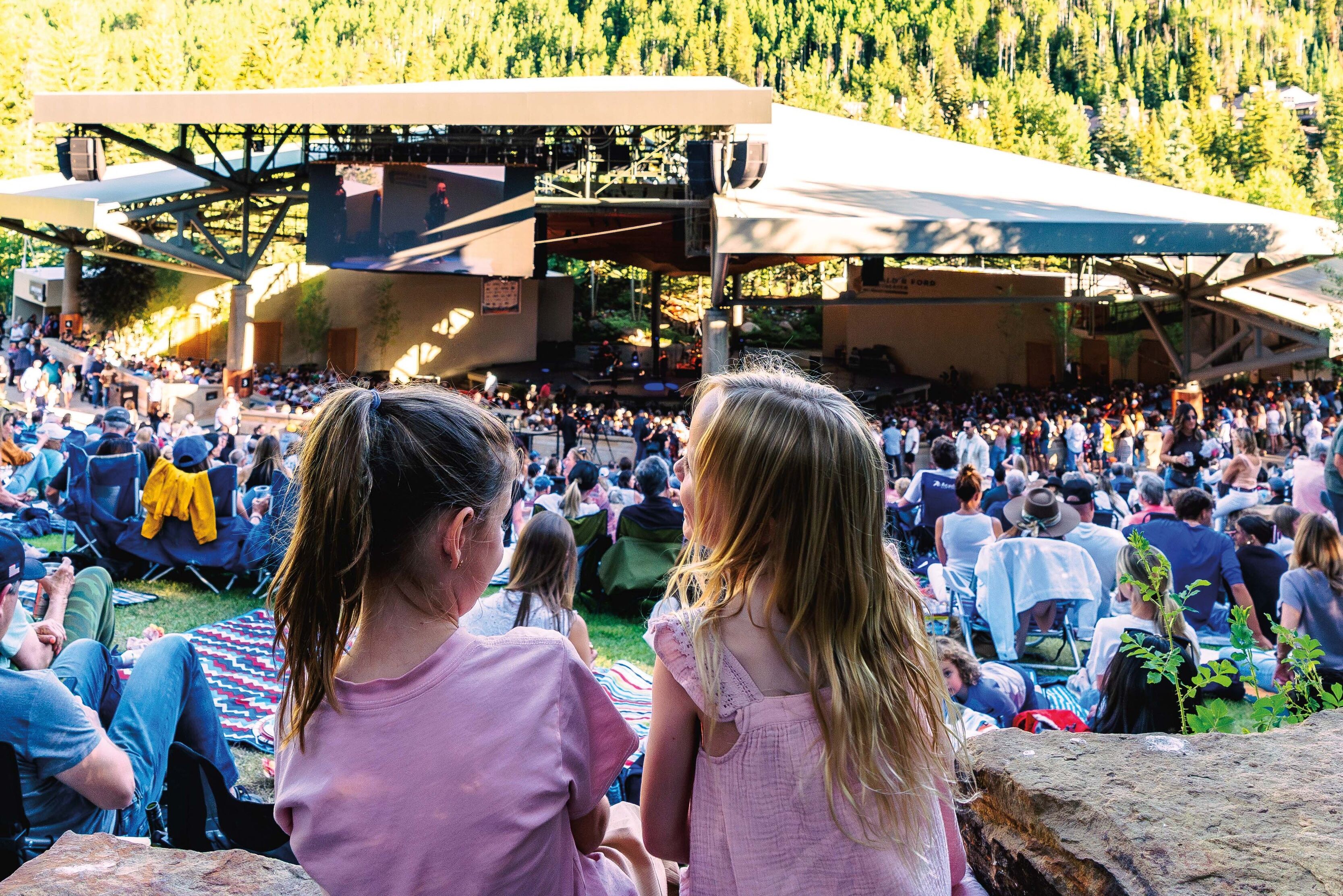
The lawn offers a perfect place to picnic and connect with friends and family—and make new friends, whether you’re a local or visitor.
“The out-of-town folks can feel like a local,” Hyde adds. “There’s a good energy there. Everybody seems to mix. The Amp just has the energy that combines nature, art, community, and fun.”
The neighboring Betty Ford Alpine Gardens, punctuated by benches and waterfalls, provides a colorful, blooming respite before and after concerts. Together, The Amp and gardens create a unique dynamic and synergy.
“The Gerald R. Ford Amphitheater has become something more than a concert venue; it has become the heart of this community,” says Frampton. “People bring their families, their friends, their neighbors. It’s what a great European town square feels like. That was never something we designed for—it just became that because the community made it their own. And, just as the community has grown and evolved, so has this venue. Every renovation has been an answer to that growth—and this current project is no different.”