Kyle Webb Is Vail Village's Go-to Architect of Luxury Homes
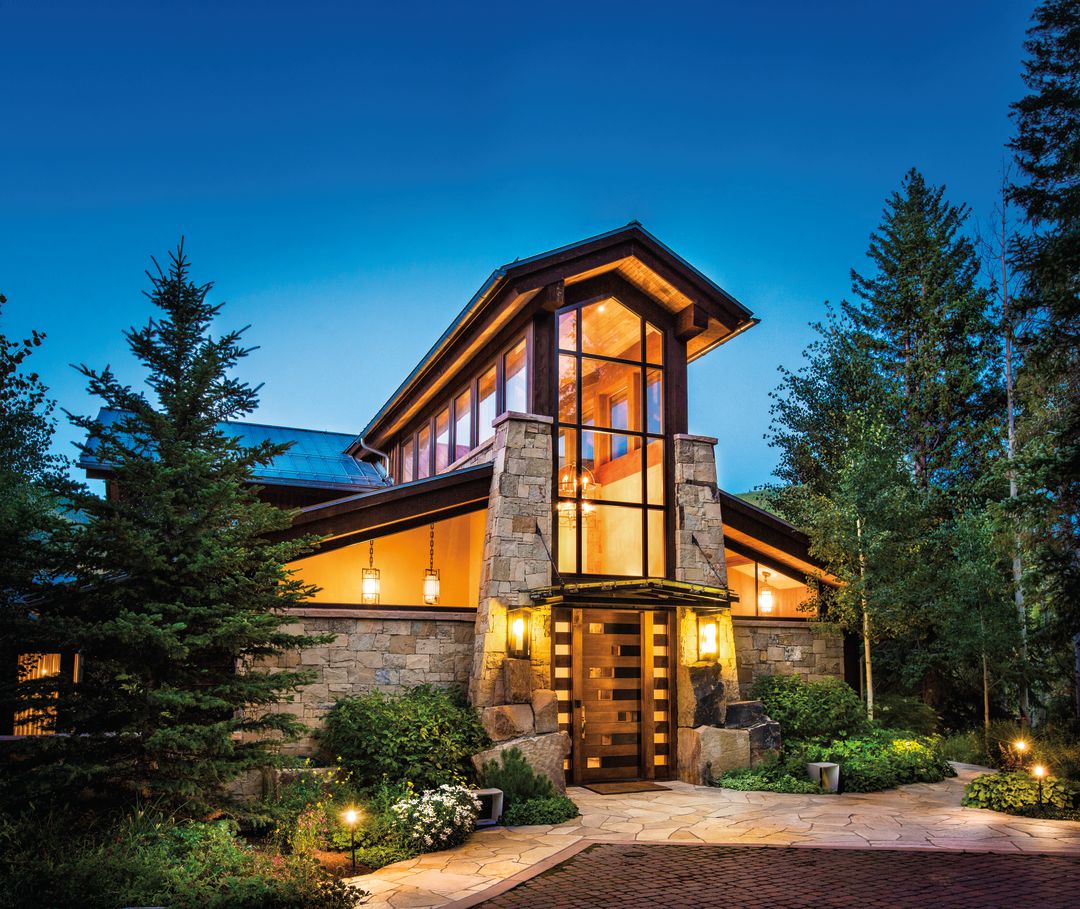
Image: Emily Minton Redfield
When Kyle Webb first visited Vail in 1977, he experienced the fledgling resort and its environs the way most people do: as a tourist, a 10-year-old on a family ski trip. As an adult, he has a different perspective. He now calls Vail his home, and as a prominent local architect (for more than three decades), Webb has literally shaped the local real estate landscape, redefining the mountain modern style by designing his unique brand of high-end homes that consistently set sales records. Yet despite that success, or perhaps because of it, he still feels childlike awe to be living in Vail nearly a half century later, and doing the work he loves.
“Vail is just one of those places,” says Webb, now 58. “I fell in love with it when I was 10 years old—the skiing, the activities, the lifestyle. I joked with my parents that I was going to live here someday, and lo and behold, it happened.”
Webb didn’t just grow up believing he would someday live in Vail. He also knew, from a very young age, that he wanted to be an architect. His father’s family business was making products for residential construction, and Webb says that his parents were constantly remodeling and redesigning their home; he was inspired early on by the design and build process.
“It was something I kind of got obsessed with very quickly,” he recalls. “My first job was with an architect who worked for my parents.”

Image: sherri innis
He earned architecture degrees from both North Carolina State University and the Catholic University of America (where he still serves on the board of advisors for the school of architecture) before making his way back to Colorado. It was a transformational time in Vail; in 1970, the town had a population of just 484, but in 1990, there were more than 3,600 permanent residents. People were no longer just looking for no-frills ski condos; they wanted somewhere to live year-round so they could embrace the mountain lifestyle, much like Webb.
When he moved to town, he gravitated toward Jim Morter, an architect who was doing innovative work in the valley, and worked at Morter Architects for eight years. In 1999, he founded his own firm, KH Webb Architects.
“I begged him for a job,” Webb recalls. “We were trying to be very unique and push modern architecture. That [collaboration] was the start of mountain modern architecture around here. Vail was created in the ’60s, so the initial architecture was alpine mountain, influenced by Austria and Switzerland.”
Webb refers to that genre jocularly as “yodel architecture,” but redesigning homes to fit a new aesthetic wasn’t just about form, it was also about function. When he worked with Morter, they mostly added bedrooms to accommodate more family members. Today’s wealthier and more discerning clients want vacation homes with more sophisticated, modern amenities. Post-pandemic must-haves now include dedicated home offices and copious wellness spaces: steam rooms, saunas, gyms, even indoor lap pools.
Because sprawl in Vail is constrained by the mountain’s topography, buildable space in and around the resort is a precious commodity, and most of the lots still left are on steep terrain, requiring complicated geotechnical engineering.
“You have to plan for avalanches and rockfall, things that aren’t present for most residential architecture,” Webb says. “Back east, we had flat lots. When I got here I was fascinated. I was presented with more challenges and opportunities and it’s been a learning experience. With new construction, I look at the site as the driver for everything. Steepness, wind exposure, sun, and where you want to be outside. Often with challenging lots, we design the driveway to see where we can get to before we design anything else.”
Because of such constraints, about half of the work Webb does involves remodeling existing homes, some dating back to the earliest days of the resort when most properties were built as weekend getaways with low ceilings, no closets, and at most a one-car garage.
“We’ve had to do some crazy adaptations,” he adds. “Like suspending a house in the air to build another level underneath it.”
Whether it’s new construction or a remodel, Webb says his homes are designed to have a longer shelf life than the ski chalets built in the ’60s. His guiding principle is to create living spaces that are both timeless and contemporary in a style that is classic and refined rather than trendy, following the model of Frank Lloyd Wright, whose designs in the early 20th century, then groundbreaking, still seem relevant and modern by today’s standards.
“Everything in design has a timeline to it,” he explains. “What we strive for is to make things have a long path. Making sure our choices will still look good in 30 years.”
Webb has also assembled a team that has staying power; the average tenure of his project managers, architects, and designers is 16 years, and that longevity, he says, is integral to the success of his namesake firm.
His reputation for elevating the modern mountain style by designing homes that are edgy, contemporary, and timeless has made his firm something of a sought-after brand in the luxury market.
You can trace this cachet back to 2005, when a couple purchased 107 Rockledge Road, fashionista Ann Taylor’s former ski-in/ski-out home at the base of the Bear Tree run—Vail Village’s first luxury residence—for $7.5 million and hired Webb to replace it with his modern reinterpretation of a luxe mountain home. Webb designed a 12,170-square-foot showpiece encased in granite masonry, with a zinc roof, imported German windows, a soaring entranceway, and an open floor plan with a cantilevered dining room overlooking the Gore Range. After Mountain Living named 107 Rockledge Road its 2010 Home of the Year, it broke local real estate records when it sold for $23 million in 2012 (and repeated the feat 12 years later, when the home again changed ownership, fetching $40 million). Webb had established himself as the go-to architect for exclusive mountain properties—and he was just getting started.
A Premier Portfolio
Luxury homes with smaller footprints are often called “jewel boxes.” One such gem designed by Webb and his team is Wild Rose in Avon’s tony Mountain Star neighborhood, which was named the 2020 Home of the Year by Colorado Homes & Lifestyles magazine and will be featured on an episode of America by Design, being filmed this fall. It’s 6,000 square feet, but with 15-foot-tall windows on every side of the living area offering panoramic views of Beaver Creek Mountain and oversize sliding glass doors, it feels both expansive and serene—connected to its natural surroundings. The artistic details are what make Wild Rose shine—cantilevered wooden stairs, porcelain tile with embedded lighting, and ornate etching on the granite fireplace are among its unique style elements.
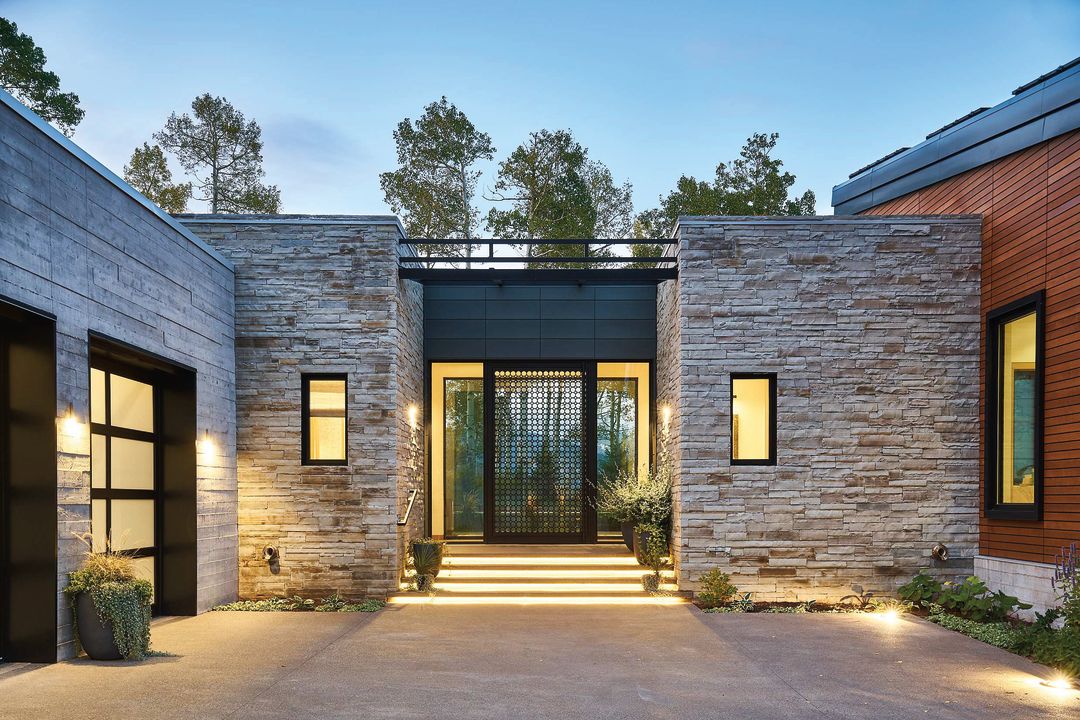
Image: david patterson

Image: david patterson

Image: david patterson
“It was a house that was all about the view,” Webb says. “We went crazy with the windows. The clients loved the minutiae, what you see in every room, and how you experience the property. It was a beautiful process to be involved with because they cared about every detail.”
Then there’s Webb’s Casteel Creek Retreat, a Xanadu-like compound with five residences (totaling 23 bedrooms and 34 bathrooms) on more than 400 acres in Lake Creek that took Webb nine years to design and was the most expensive listing in Colorado when it hit the market for $78 million in 2019 (ultimately, it sold for a relative bargain, fetching $42 million in 2022).

Image: courtesy Kyle Webb
In January 2025, The Wall Street Journal declared 100 Vail Road (dubbed Alpenstrasse) Colorado’s most expensive home after it listed for $78 million, and it seemed poised to break another record until billionaires Lynda and Stewart Resnick listed their Aspen estate for $300 million in August. The 15,000-square-foot, six-level Alpenstrasse was originally a single residence built by the Merriam-Webster family, then was remodeled as a duplex and sold to Boulder biotech entrepreneur Kevin Ness for $57.2 million in 2020, then a record sale for the region. Ness hired Webb and his team to remodel the 11-bedroom, 18-bathroom property (the largest in Vail) to again function as a primary residence that can be reconfigured to also serve as a pied-à-terre for guests or family members. A suplex, if you will.
“It is technically two homes, but they wanted the ability to have a lock-off but with access,” says Tye Stockton, the home’s listing agent. “It meant creating a lot of flexibility, and Kyle was masterful in navigating that.”
Stockton says Webb succeeds because he’s a great listener with enough experience to know what is possible and how to do it.
“Clients just love him, and he has a great rapport with the Town of Vail, where his properties have set the high mark for value,” adds Stockton. “He is a consensus builder with a history of working with all the parties: buyers, sellers, realtors, the town. It’s important to have somebody that quarterbacks all that, and his knowledge is almost second-to-none.”
At press time, several high-end Webb-designed luxury homes were on the market in Vail Village, including 366 Forest Road, a stunning six-bedroom, nine-bathroom home with ski-in and ski-out access for $28.2 million, and 1150 Ptarmigan Road, a sleek five-bedroom, seven-bathroom spec home with a sumptuous chef’s kitchen, under construction adjacent to the Vail Golf Course, for $25 million.

Image: Brent Bingham

Image: Brent Bingham
Yet Webb doesn’t measure his success in terms of sales figures. Just as, if not more, meaningful is the pro bono work he does for the community, like designing a pair of luxury penthouses Ski & Snowboard Club Vail used to fund construction of its $28 million clubhouse on Golden Peak in 2018, mentoring a group of aspiring high school architects, and sitting on the board of Bravo! Vail—the civic roles that cement his place in this community.
“It’s an awesome position to be in, to be able to make amazing things,” says Webb. “That’s the best part of being an architect, being able to make people’s dreams come true.”
Including his own: Doing meaningful work, while living in this beautiful place he calls home.